Introduction
Placement season is one of the most important phases in a student’s life. It is the bridge between your academic journey and your professional career. For many freshers, this phase brings a mix of excitement, pressure, confusion, and self-doubt.
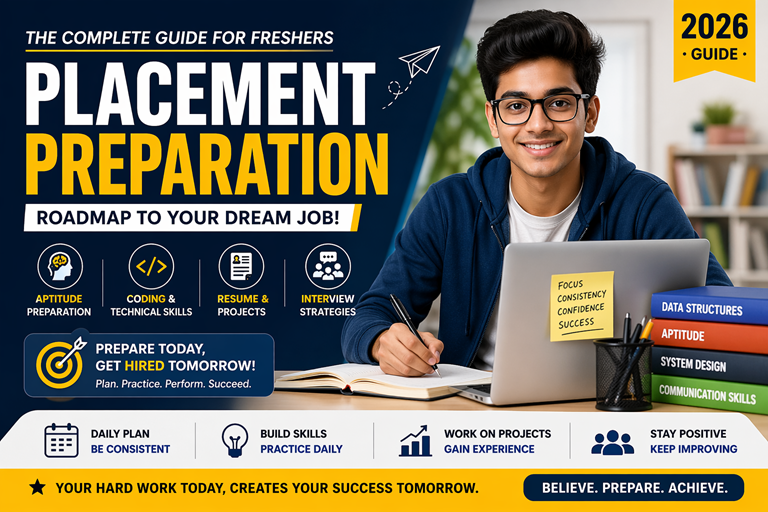
The good news is — placements are not about luck. They are about preparation, consistency, and strategy. This guide will give you a complete roadmap to prepare for placements step by step, helping you build confidence and crack your first job successfully.
Understanding the Placement Process
Before you start preparation, it is important to understand how the placement process works. Most companies follow a structured hiring process.
- Online Aptitude Test (Quantitative, Logical, Verbal)
- Technical Assessment (Coding / Core Subjects)
- Technical Interview
- HR Interview
Some companies may skip certain rounds, but the overall structure remains similar. Knowing this helps you prepare smartly instead of randomly.
Step 1: Build the Right Mindset
Your mindset matters more than your marks. Many students fail not because they lack knowledge, but because they lack confidence and consistency.
- Stop comparing yourself with others
- Focus on daily improvement
- Accept failures as part of learning
- Stay disciplined and consistent
Step 2: Aptitude Preparation (Very Important for Freshers)
Aptitude tests are often the first elimination round. Many good students get rejected here because they underestimate its importance.
- Quantitative Aptitude (Percentages, Profit & Loss, Time & Work, Speed & Distance)
- Logical Reasoning (Puzzles, Seating Arrangement, Blood Relations)
- Verbal Ability (Grammar, Reading Comprehension, Vocabulary)
Recommended platforms to practice aptitude:
- https://www.indiabix.com
- https://www.placementseason.com
- https://www.geeksforgeeks.org
Step 3: Technical Skills Preparation
Technical preparation depends on your field. For IT and software roles, focus on coding and core concepts. For other branches, focus on fundamentals of your domain.
For IT / Software Students
- Learn one programming language (Java, Python, or C++)
- Understand Data Structures & Algorithms (DSA)
- Practice coding problems daily
- Learn DBMS, OS, and Computer Networks basics
Practice coding on:
- https://leetcode.com
- https://www.hackerrank.com
- https://www.codechef.com
For Non-IT Students
- Focus on core subjects (Mechanical, Civil, Electrical basics)
- Understand practical applications
- Prepare for technical interviews based on your branch
Step 4: Build Strong Projects
Projects are your biggest strength as a fresher. They prove your practical knowledge and make your resume stand out.
- Build 2–3 real-world projects
- Host your projects on GitHub
- Explain your project clearly (problem, solution, tech stack)
- Add live demo if possible
GitHub: https://github.com
Step 5: Resume Building
Your resume is your first impression. A strong resume increases your chances of getting shortlisted.
- Keep it one page
- Highlight skills, projects, and achievements
- Use simple and clean format
- Avoid spelling mistakes
Free resume builder: https://www.overleaf.com (LaTeX templates)
Step 6: Interview Preparation
Interviews test both your knowledge and communication skills. Preparation is the key to performing well.
Technical Interview Tips
- Revise fundamentals regularly
- Practice explaining concepts clearly
- Be honest if you don’t know an answer
- Think out loud while solving problems
HR Interview Tips
- Prepare common questions (Tell me about yourself, strengths, weaknesses)
- Maintain positive body language
- Be confident and polite
- Research the company before interview
Step 7: Improve Communication Skills
Good communication can make a huge difference in interviews. Even if you have knowledge, you must be able to express it clearly.
- Practice speaking in English daily
- Watch English videos and interviews
- Participate in mock interviews
- Record yourself and improve
Common Mistakes Freshers Make
- Starting preparation too late
- Ignoring aptitude round
- Copying projects without understanding
- Not practicing interviews
- Lack of consistency
Daily Study Plan (Example)
- 1 hour aptitude practice
- 2 hours coding / core subject
- 1 hour project work
- 30 mins communication practice
Final Motivation & Confidence Boost
Remember — every successful professional was once a fresher with doubts and fears. What made them successful was not talent alone, but consistent effort and the willingness to improve every day.
You don’t need to be perfect. You just need to be better than yesterday. Even small daily progress can lead to big results over time.
Rejections are not failures — they are feedback. Learn from each attempt, improve, and come back stronger. Your first job is not the final destination, but the beginning of your journey.
Conclusion
Placement preparation is a journey that requires planning, patience, and persistence. Focus on building skills, practicing regularly, and improving your confidence. Follow this roadmap, stay consistent, and you will definitely achieve your goal.