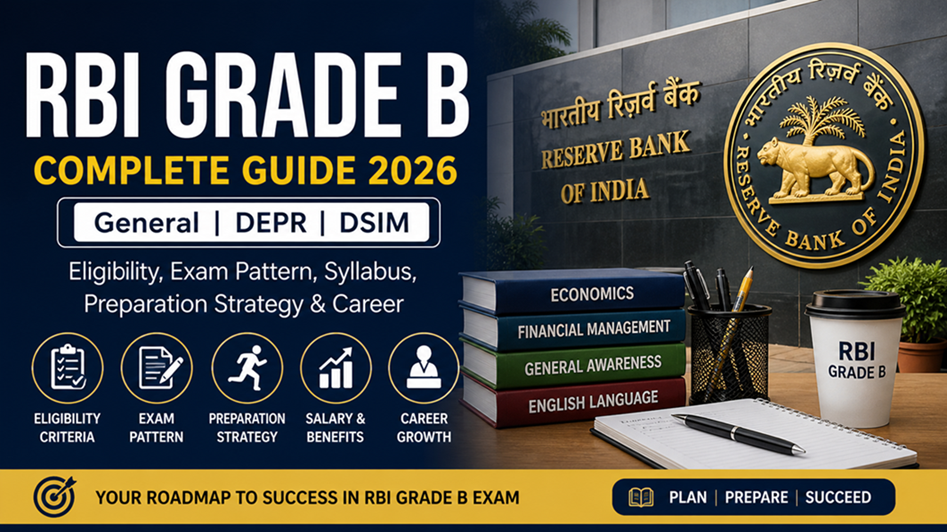
Introduction: Why RBI Grade B is One of the Most Prestigious Careers in India
The RBI Grade B Officer exam is one of the most sought-after government exams in India. Conducted by the Reserve Bank of India, it offers candidates an opportunity to work at the core of India’s financial system. This role is not just about a job—it is about contributing to national economic policy, financial stability, and governance.
Candidates selected for RBI Grade B become officers responsible for regulating banks, controlling inflation, managing currency, and framing monetary policies. Due to its high prestige, salary, and work-life balance, lakhs of aspirants compete every year.
Streams in RBI Grade B Recruitment
RBI Grade B recruitment is conducted for three main streams. Each stream requires different expertise and academic background.
- General Stream – Open for graduates from any discipline
- DEPR – Focused on Economics and policy research
- DSIM – Focused on Statistics, Data Science, and analytics
Eligibility Criteria for RBI Grade B 2026
Educational Qualification
- General: Graduation with minimum 60% marks (50% for reserved categories)
- DEPR: Master’s degree in Economics or Econometrics
- DSIM: Master’s degree in Statistics, Mathematics, or Data Science
Age Limit
Candidates must be between 21 and 30 years. Age relaxation is applicable for reserved categories as per government rules.
Number of Attempts
General category candidates typically have limited attempts, while reserved categories get additional attempts.
Exam Pattern (Stage-wise Breakdown)
Phase 1 (Preliminary Exam)
Phase 1 is an objective exam that tests basic aptitude and general awareness. It is qualifying in nature.
- General Awareness – 80 marks
- Quantitative Aptitude – 30 marks
- Reasoning – 60 marks
- English Language – 30 marks
Phase 2 (Mains Exam)
Phase 2 is the most critical stage and determines final selection.
- Economic & Social Issues (ESI)
- Finance & Management (FM)
- English Descriptive (Essay + Writing)
Interview
The final stage evaluates personality, communication skills, and domain knowledge.
Detailed Syllabus
General Awareness
Includes banking awareness, economic news, RBI policies, and current affairs.
Economic & Social Issues (ESI)
Covers Indian economy, poverty, globalization, sustainable development, and government schemes.
Finance & Management
Includes financial systems, markets, risk management, leadership, and organizational behavior.
Salary and Benefits
RBI Grade B offers one of the highest salaries among government jobs.
- Basic Pay: ₹55,200+
- Gross Salary: ₹1,00,000+ per month
- Perks: Housing, medical, education allowance
- Work-life balance and job security
Preparation Strategy (Step-by-Step)
Step 1: Understand the Exam
Start by analyzing syllabus and previous year papers.
Step 2: Build Strong Basics
Focus on conceptual clarity in Quant, Reasoning, and Economics.
Step 3: Current Affairs Mastery
Daily reading of economic news and RBI updates is essential.
Step 4: Mock Tests
Practice regularly to improve speed and accuracy.
Step 5: Answer Writing Practice
Develop writing skills for Phase 2 descriptive papers.
6-Week Study Plan
- Week 1-2: Basics of all subjects
- Week 3-4: Cover ESI and FM thoroughly
- Week 5: Practice mocks + revise
- Week 6: Full revision + answer writing
Common Mistakes to Avoid
- Ignoring Phase 2 preparation
- Not reading current affairs daily
- Skipping mock tests
- Poor time management
Final Motivation
RBI Grade B is a challenging exam, but with dedication, smart strategy, and consistency, it is absolutely achievable. Thousands of candidates succeed every year, and with the right approach, you can be one of them.
Conclusion
RBI Grade B offers prestige, financial stability, and an opportunity to contribute to the nation’s economic system. With proper preparation and discipline, cracking this exam is achievable.