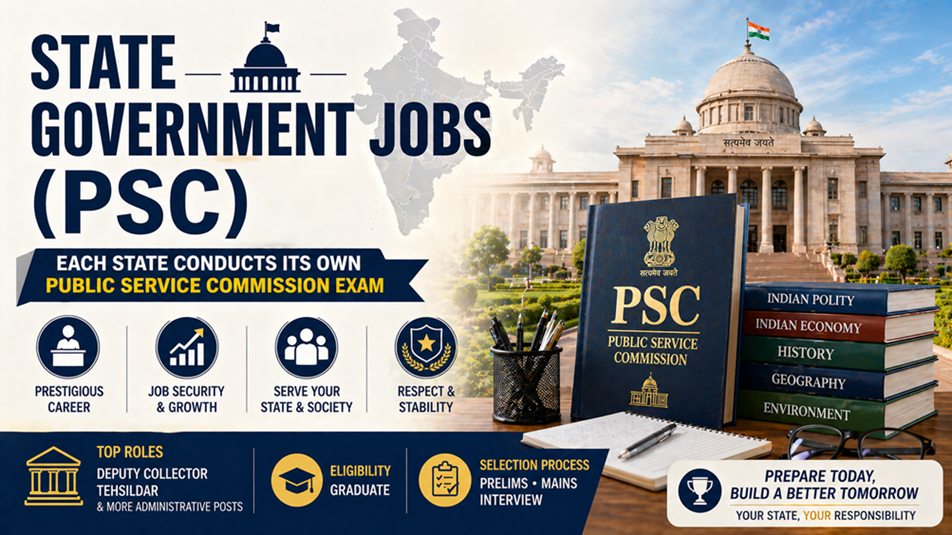
Introduction: Why State Government Jobs (PSC) Are a Powerful Career Choice
State Government jobs through Public Service Commissions (PSC) are among the most respected and stable career options in India. Every state has its own PSC such as MPSC (Maharashtra), UPPSC (Uttar Pradesh), GPSC (Gujarat), and others, which conduct exams to recruit officers for administrative roles within the state.
These roles allow candidates to work closely with state governance, administration, and public service delivery. Positions like Deputy Collector and Tehsildar carry significant authority, responsibility, and social respect.
What is PSC (Public Service Commission)?
Public Service Commission (PSC) is a state-level body responsible for recruiting candidates for various government departments within a state. Similar to UPSC at the national level, PSC exams are conducted to select candidates for administrative and civil services roles at the state level.
Each state conducts its own PSC exam with a slightly different syllabus and pattern, but the overall structure remains similar across states.
Official PSC Websites (Examples)
Top Roles Offered Through PSC Exams
1. Deputy Collector
Deputy Collector is one of the most prestigious state-level administrative positions. The officer is responsible for district administration, revenue management, and implementation of government policies.
- Role: Administrative head at district/sub-division level
- Responsibilities: Law & order, policy implementation
- Growth: Can be promoted to higher administrative roles
2. Tehsildar
Tehsildar manages revenue collection and land records at the tehsil level. It is a key role in rural administration.
- Role: Revenue officer at tehsil level
- Responsibilities: Land records, tax collection
- Work Area: Rural and semi-urban regions
Other Important Roles
- Deputy Superintendent of Police (DSP)
- Block Development Officer (BDO)
- Excise Officer
- Commercial Tax Officer
Eligibility Criteria for PSC Exams
- Educational Qualification: Graduation in any discipline
- Age Limit: 21 to 38 years (varies by state)
- Nationality: Indian citizen
Age relaxation is applicable for reserved categories as per government rules.
PSC Exam Pattern (General Structure)
Most PSC exams follow a three-stage selection process similar to UPSC.
- Preliminary Exam (Objective)
- Mains Exam (Descriptive)
- Interview / Personality Test
PSC Syllabus (Detailed Overview)
The syllabus generally includes both general studies and state-specific topics.
- History (India + State)
- Geography (India + State)
- Polity and Governance
- Economy
- Current Affairs
- Environment and Science
Salary and Benefits
PSC officers receive attractive salary along with government benefits.
- Salary: ₹50,000 to ₹1,00,000+
- Allowances: DA, HRA, Travel Allowance
- Government accommodation
- Job security and pension
Preparation Strategy for PSC Exams
Step 1: Understand Syllabus
Go through your state PSC syllabus thoroughly.
Step 2: Build Strong Basics
Start with NCERT books for fundamentals.
Step 3: Focus on State-Specific Topics
Prepare your state history, geography, and current affairs in detail.
Step 4: Practice Answer Writing
For mains exam, practice writing structured answers.
Step 5: Mock Tests & Revision
Take mock tests regularly and revise consistently.
Common Mistakes to Avoid
- Ignoring state-specific syllabus
- Lack of answer writing practice
- Not revising regularly
- Studying without strategy
Motivation & Final Advice
State PSC exams provide an opportunity to serve your own state and make a real impact on society. It is a highly respected career path that requires dedication and discipline.
Conclusion
State Government jobs through PSC offer stability, respect, and meaningful work. With the right preparation strategy and mindset, you can crack PSC exams and build a powerful career in public service.